LIVEEarly Access since Oct 9, 2026Game v0.1.50.17746Steam reviews Very Positive · 91% (209)Facts checked Oct 11, 2026Patch notes →
Money & Profit Guide 2026
Japanese Ramen Simulator Money Guide: EA Profit Loop (2026)
Steam Early Access is live (v0.1.50.17746). Cash-loop order from official store footage plus Day 1 patch money changes; unannounced prices stay unannounced; creator-preview numbers are labeled pre-launch observations. Unofficial fan wiki.
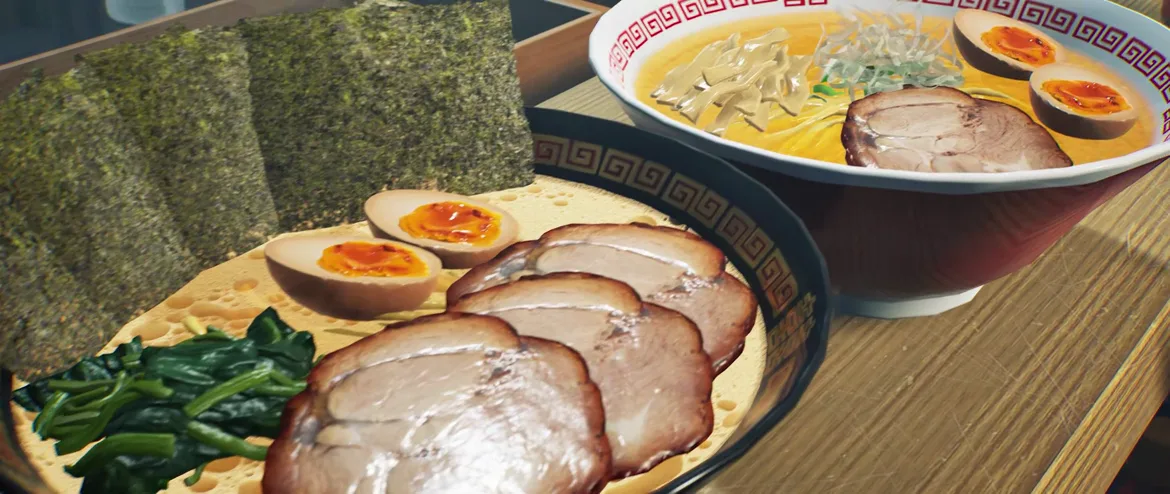
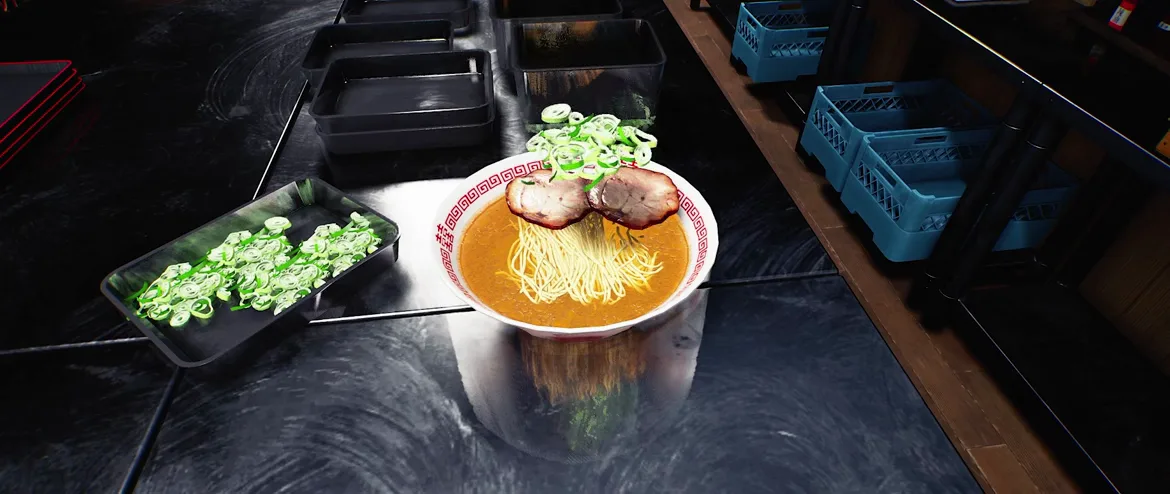
📸 This is the only frame in the official footage that lets you judge what goes into a bowl. Price is still unannounced, so what you can compare here is the topping load, not the margin.▶ See this shot in the official Steam store footage: (~0.5s)
First, the split: what is confirmed and what is blank
Early Access started 2026-10-09 (current patch v0.1.50.17746). Per-bowl prices and many economy figures are still not announced. Official Day 1 money changes are in the section below; the nine-step loop still follows store footage.
Bowl price, cost, marginNot announced
No price tags in store text or clips. /recipes figures are site-model placeholders, not verified in-game values.
Day 1 money changesDifficulty pay · Boss cash · Beer scoring
Easy ×1.4, Normal ×1.2, Hard/Very Hard unchanged (same order & review). First-clear boss customers pay cash (amount unannounced). Beer+foam ≤70% cup volume penalized.
Gambling hallExists / contents unknown
One official sentence about earning shop money. Odds and games unannounced.
Labour & gearHiring official / wages TBA
Day 1 adds dish-clearing staff. /upgrades ROI is site model; patches on /changelog.
Day 1 money-related changes (v0.1.48.17626)
OFFICIAL
Excerpted from the official Day 1 patch notes. Items without a stated amount stay unannounced.
OFFICIALDifficulty payment multipliers (same order, same review): Easy ×1.4, Normal ×1.2, Hard / Very Hard unchanged
OFFICIALFirst time you defeat/clear each boss customer grants cash (amount not stated in the patch)
OFFICIALEgg cartons: buy up to 6 per order, then reorder
OFFICIALBeer scoring: beer + foam ≤ 70% of cup volume is penalized; no foam triggers a warning comment but no penalty for lacking foam alone
Store clips predate the live EA build. Creator-preview numbers may differ — prefer /changelog and in-game UI.
How we label data
This is an unofficial fan wiki. Each claim carries a source label so you can tell what the developer confirmed from what we estimated.
OFFICIALFrom the Steam store page, official announcements or patch notes.
OBSERVEDSeen in gameplay footage or hands-on builds; the release build may differ.
PLAYER REPORTReported by players on Steam; we have not reproduced it.
SITE MODELA calculation or estimate built by this site — not an in-game value.
The cash loop: what to fatten, what to squeeze
Income has two channels — internal (bowls, sides, drinks) and external (the gambling hall). Outflow is ingredient cost plus labour and equipment. Our organised data lives on these pages.
Cost side (steps 01-03): tighten the leak before chasing the sale
Profit is price times volume minus cost. With price unannounced, the only side you can act on today is cost and waste. The official footage walks from opening a delivery box to scrubbing bones in the sink, which is the evidence that a purchasing-and-prep stage exists at all.
STEP 01
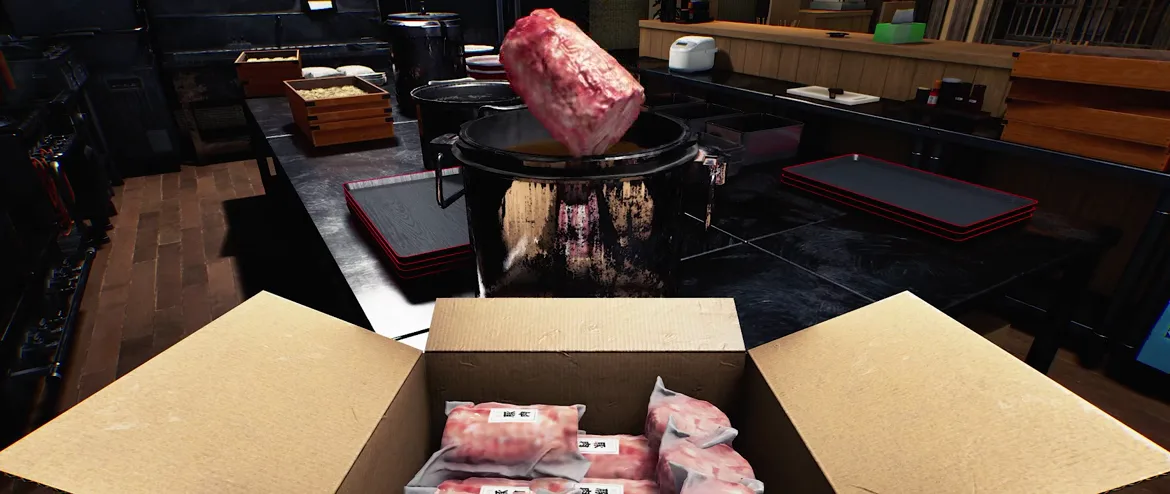
Open the cardboard delivery box of vacuum-packed pork
First person, the flaps of a kraft-paper shipping box folded outward, inside a stack of vacuum-sealed raw pork blocks each carrying a small white label with two Japanese characters. Behind it, a soot-blackened stockpot sits on the counter with a larger piece of meat lifted over its mouth. Because restocking exists, purchase price is the denominator of every profit claim — and it is unannounced. Our ingredient cost sheet is on /ingredients; the full terminal → street box → fridge loop is on /guides/restock-delivery-guide.
📸 Step 01 · The restock moment. No purchase price appears on screen anywhere in the clip.
STEP 02
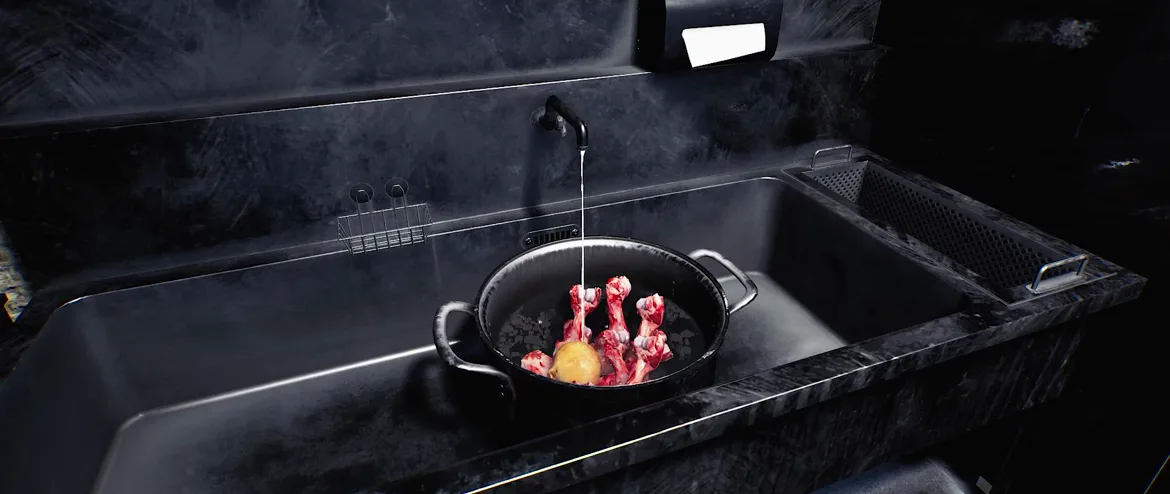
Rinse and blanch the bones in the sink
A black two-handled pot sits in a stainless double sink, a thin stream from the gooseneck tap falling into it, five or six meaty bone pieces standing upright inside plus one round aromatic. This is the invisible labour line: time you spend here is time not spent at the pass. Equipment that automates this kind of task is where the payback argument usually starts.
📸 Step 02 · Broth prep is a wage you pay with your own minutes.
STEP 03
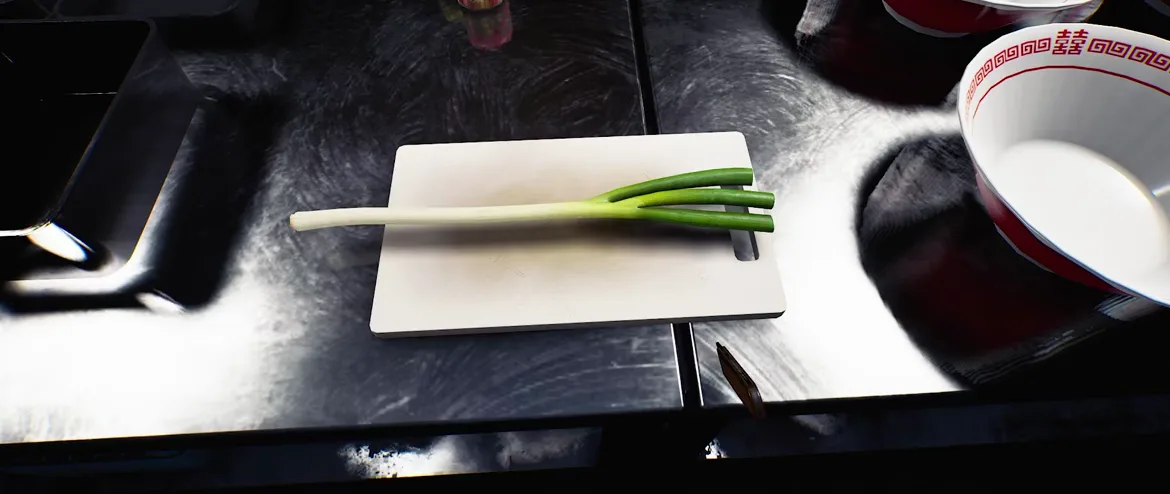
One whole scallion on the white board: mise en place
A white plastic cutting board on a dark stone-look counter, one uncut scallion lying across it, white root end left and three green stalks right, the tip of a knife just visible at the board edge, an empty red-and-white patterned bowl at the top right. As long as garnish is cut one stalk at a time, bowls per hour has a ceiling — which is the real argument for staffing and layout.
📸 Step 03 · Before talking ticket size, count the hand movements per bowl.
Traffic side (steps 04-06): nothing is earned while the door is shut
Three frames shot outside the shop: the street-front building, figures sprinting for the entrance, the wooden open sign going up on the wall. The first multiplication in any revenue formula is arrivals times bowls served.
STEP 04
The two-storey corner building: the container for traffic
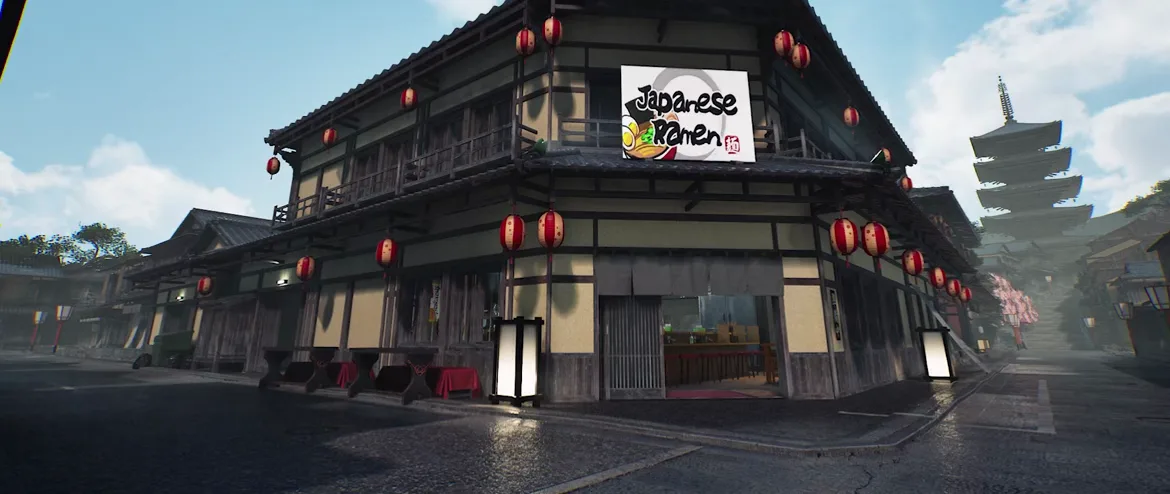
A wooden two-storey corner shop lined with red lanterns on wet asphalt, a white signboard on the upper corner reading Japanese Ramen with a bowl illustration and a red seal character, a dark noren over the entrance and paper floor lanterns either side. Nobody is walking yet in this frame — the vessel exists, the volume does not. Whether storefront and decoration pull customers is not something the developer has put numbers on.
📸 Step 04 · The shop front, with the sign text legible enough to read in the footage.
STEP 05
Figures sprinting for the entrance: arrivals start the meter
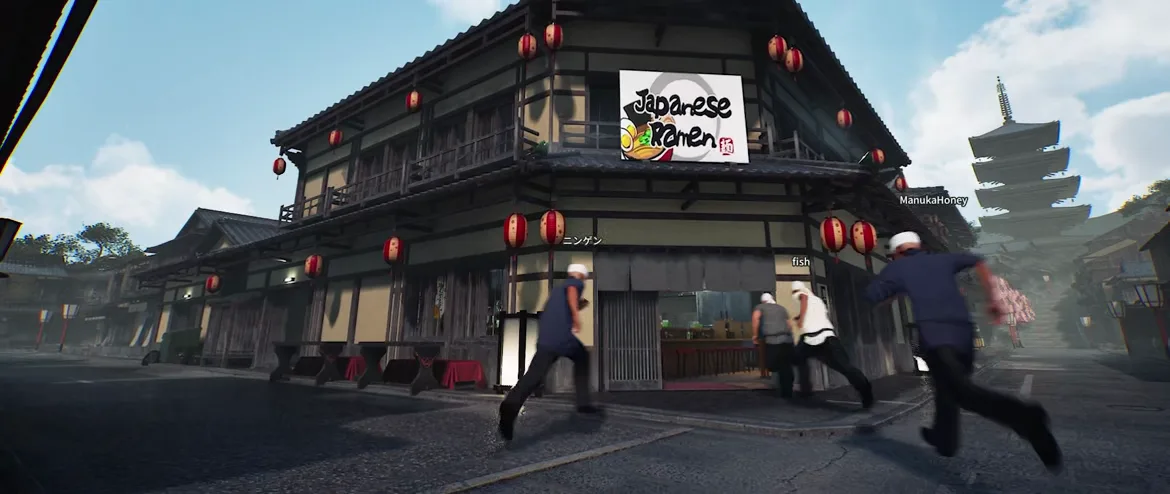
The same corner shop, four characters running in from both sides toward the noren, three of them carrying white name tags overhead (ManukaHoney, ニンゲン, fish), which tells you this frame was captured during a multiplayer session. Arrivals times orders times turnover is the front of the revenue equation; footfall rates, dwell time and tipping are all unannounced.
📸 Step 05 · A frame where the crowd and the co-op session appear together.
STEP 06
Hanging the open sign on the outside wall
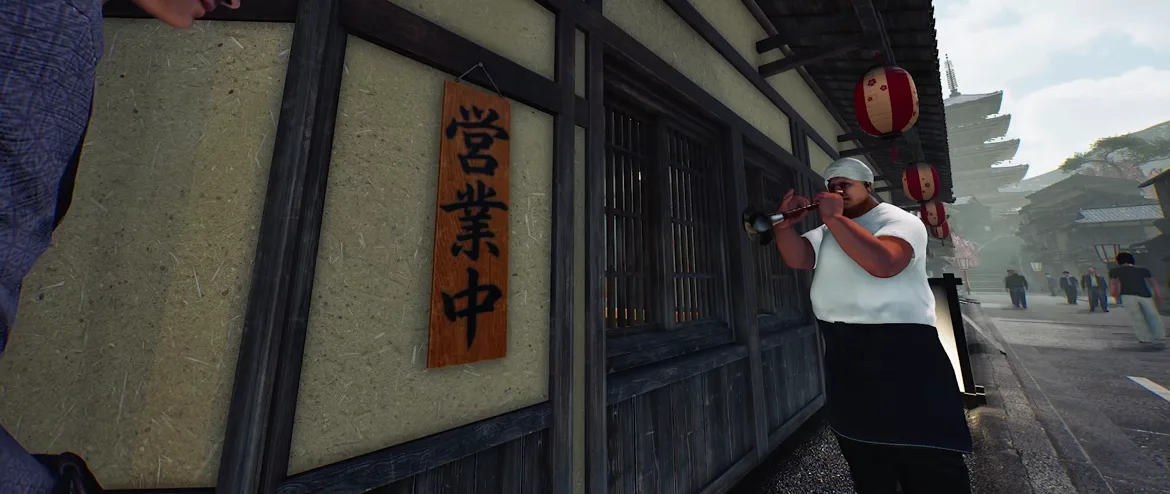
A vertical wooden plaque with open-for-business written in black brush strokes hangs on the plastered wall; to its right a broad man in a white t-shirt, white head wrap, black apron and sunglasses stands by the wall holding a handled tool, with lanterns, the pagoda and pedestrians behind. That a daily opening action exists is visible; how long a service day runs and how many shifts fit inside it is not.
📸 Step 06 · Opening the shop is a real action in the footage; the length of the day is still blank.
Revenue side (steps 07-09): keep the bowl moving, then add a second item
Plating on the pass, a tray with beer and gyoza, and handing a station to somebody else. The store text names gyoza, rice bowls and the beer-to-foam balance, so these are the official ticket-size levers.
STEP 07
The finished bowl on the pass: the unit of income
Overhead on the dark counter, a white bowl with a red key pattern holding orange-brown broth, a bundle of noodles lifted in the centre, two chashu slices and a mound of scallion rings. A black tray of cut scallions sits left, blue plastic crates stack on the shelf right. The store text tells you to watch noodle texture, broth temperature, aroma, umami and serve time — so quality gates exist, thresholds do not have published numbers.
📸 Step 07 · One bowl, the smallest unit of income on this page.
STEP 08
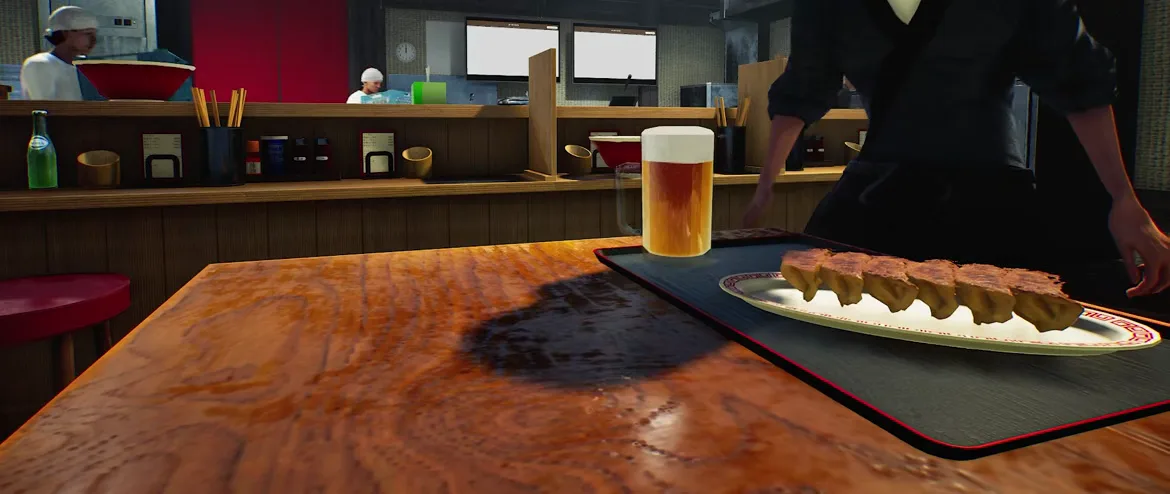
Beer and gyoza on one tray: the ticket-size lever
On a wooden table, a black tray with a red rim carries a tall mug with a thick foam head and an oval plate of six pan-fried gyoza in a row, while a figure in black sets it down with both hands. Behind: the wooden bar counter, a red wall, two white menu boards, a clock and condiment pots. The official text names gyoza and the balance of beer and foam, so the add-on path is real. Day 1 (v0.1.48.17626) official: beer + foam at or below 70% of cup volume is penalized; no foam can warn without a penalty for lacking foam alone — see /guides/beer-pouring-guide. Per-item prices and attach rates are not announced.
📸 Step 08 · Two items on this tray — no dessert is visible in this particular frame.
STEP 09
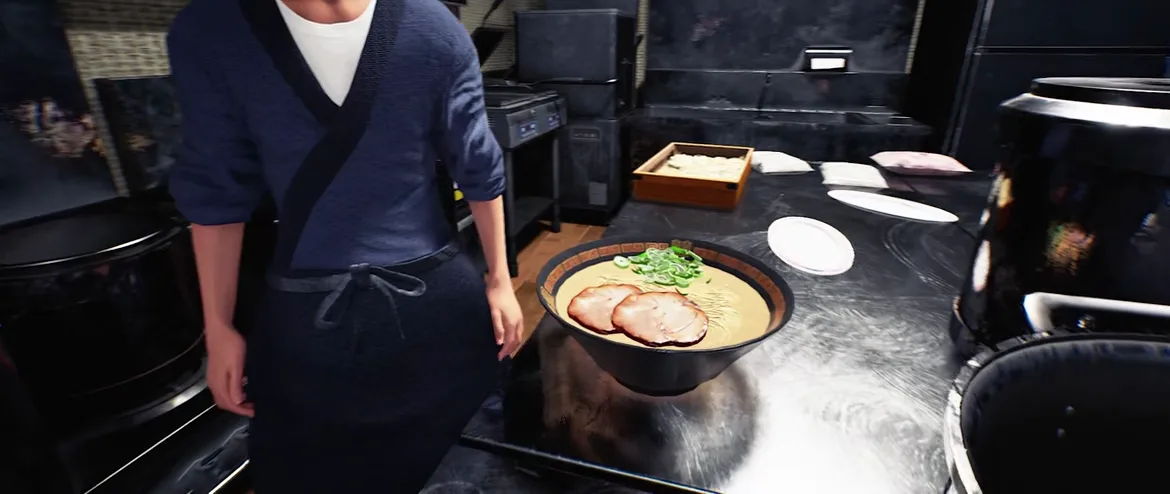
Hand the station over: spend your own hours on the highest-value task
A figure in a navy samue jacket and black apron stands beside the black pass, where a black bowl of yellow broth carries two chashu slices and scallions; stockpots, a wooden noodle box and white plates fill the counter behind. The store text explicitly says you can hire part-time staff to run the shop solo at your own pace. Day 1 (v0.1.48.17626) adds dish-clearing staff for plates, trays and empty bottles. Whether the person in a frame is the player or a hire cannot be told from appearance, so we phrase this as handing work off. Hiring notes: /guides/staff-hiring-guide.
📸 Step 09 · The hand-off. Wages are unannounced, so decide the order of what you delegate first.
Income sources compared: what is confirmed, what is blank
Before answering which dish earns most, separate the income sources the developer has acknowledged from the ones where every figure is still missing.
Income source
Backed by store text
Visible in footage
Number status
A bowl of ramen
Yes (serving flow described)
Yes (steps 07 / 09)
Price and cost unannounced
Gyoza and other sides
Yes (Cook gyoza and rice bowls)
Yes (step 08)
Unannounced
Draft beer
Yes (right balance of beer and foam)
Yes (step 08)
Unannounced
Rice bowls (chashu rice bowl)
Yes (chashu rice bowls)
Not in these four clips
Unannounced
Part-time staff (freed time)
Yes (Hire part-time staff)
Other clips show multiple workers
Wage and headcount unannounced
Equipment upgrades
Yes (Place cooking equipment)
Not in the frames on this page
Prices and payback unannounced
Gambling hall
Yes (earn money for the business)
Not shown in any clip
Game types and odds unannounced
The store-text column refers to the detailed description on the Steam page. Where our own review of the footage found nothing, that is stated rather than inferred.
Our working numbers (not official values)
OBSERVEDSITE MODEL
These are the placeholder figures our /recipes and /upgrades pages currently carry. They were filled in from conventions of the genre, not published by the developer.
From pre-launch creator preview footage — may differ in the live game. Prefer in-game numbers and /changelog.
Entry (our data page)
Our cost
Our price
Our margin
Official value
Draft beer (/recipes)
$80
$420
+425%
Not announced
Crispy winged gyoza, 6 pcs (/recipes)
$110
$480
+336%
Not announced
Black garlic tonkotsu (/recipes)
$380
$1,220
+221%
Not announced
Dishwasher (/upgrades)
$45,000 install
—
1.5-day payback, our estimate
Not announced
Dual beer dispenser (/upgrades)
$32,000 install
—
1.2-day payback, our estimate
Not announced
Site-model placeholders only. Steam achievements use dollar wording (e.g. $10,000 total sales). Per-item prices remain unannounced; creator-preview values may have changed in EA.
The gambling hall (casino): the external cash-injection slot
The detailed description on the official Steam page contains exactly one sentence about this, in the context of shop money:
“You can even try your luck at the gambling hall to earn money for the business.”— Steam store page, detailed description
That one sentence is the entire first-hand record: "You can even try your luck at the gambling hall to earn money for the business." The developer states its purpose as earning money for the business, so it is part of the economy, not decoration. Everything past that line is unannounced.
The blank list: which mini-games you can play, the odds, per-bet limits, what happens when funds run out, how the hall unlocks and how far it is from the kitchen. None of the four clips we reviewed (prep, restock, street front, serving) contains a single frame of the gambling hall, so we do not describe any gameplay.
Where it sits in the cash loop: bowls, sides and drinks are internal income governed by cost and turnover; the gambling hall is external injection governed by variance. Mixing the two in one payback table lets luck contaminate capital decisions. For now we keep it in a separate slot, reachable only after working capital is safe.
Risk stated plainly: with odds unannounced we will not write "double your stake at the gambling hall" into any route. If measurement shows negative expectation, that is a leak, not an earning method.
This is about in-game virtual currency only. It has nothing to do with real-money gambling, betting or slots.
The dedicated page is now live: /guides/casino-guide expands this section with the full fact/blank split, the compliance note and our post-launch test plan. Open the casino guide →
Frequently asked questions
Q1.How much does a bowl sell for in Japanese Ramen Simulator?
Not announced. No price tags in store text or clips. /recipes uses site-model placeholders. Steam achievements cite dollar totals (e.g. $10,000 lifetime sales).
Q2.Does difficulty change how much customers pay? (Day 1)
Day 1 official (v0.1.48.17626): for the same order and review, Easy pays ×1.4, Normal ×1.2, Hard / Very Hard unchanged. See /changelog.
Q3.Do boss customers give cash?
Day 1 official: first defeat/clear of each boss customer grants cash. The patch does not state the amount (unannounced).
Q4.Does under-pouring beer hurt your score?
Day 1 official: beer + foam at or below 70% of cup volume is penalized. Serving without foam can trigger a warning comment but is not penalized on its own. See /guides/beer-pouring-guide.
Q5.What is the fastest way to make money?
Without a full price sheet we cannot rank yields. Order of operations: cut waste, cover rush hours, upsell drinks/sides, use difficulty multipliers on Easy/Normal, check /upgrades (site model), collect first-clear boss cash, treat the gambling hall as spare-capital risk only.
Q6.Should I trust specific numbers on other sites?
Split official text, store footage, site models, and pre-launch creator observations. Our placeholder table is OBSERVED + site model — verify against /changelog and the live game.